
The living universe story
David Korten, member of the Club of Rome and President of the Living Economies Forum
15 April 2026
We humans live by the stories by which we know each other and our relationship to the people and place where we live. At the deepest level, our stories answer three primal questions: Who are we? Where do we come from? And what purpose are we here to serve? These questions lead us to a yet deeper question. What is the purpose of the creation of which we are a part?
My conversations with Thomas Berry in the mid-1990s had a big impact on my answers to these questions. We had frequent exchanges during his final years. I was deeply moved by his description of the universe, not as a finished product, but rather as a self-organising, unfolding process.
He argued that meaning and direction are disclosed through what he called cosmogenesis—the ongoing creativity of the universe. He viewed humans as “that being in whom the universe becomes conscious of itself.” For me, that gave us humans a profoundly important role to knowingly participate in the unfolding of the cosmos.
We are a species currently in deep crisis. We have put ourselves on a path toward self-extinction that could set back creation’s journey by millions of years. Our time has come to embrace the reality that we are living beings with distinctive abilities and responsibilities on a living Earth within a living universe continuously unfolding toward ever greater complexity, beauty, awareness and possibility.
So far as we yet know, Earth is distinctive among all the planets of the cosmos, and humans are distinctive among all of Earth’s living beings. We are currently in crisis, in part, because we have convinced ourselves that we are creation’s final purpose, the end game. We assume that this gives us distinctive rights. We are now awakening to the reality that we are participants with distinctive responsibilities in a longer journey.
Our extraordinary breakthroughs in scientific understanding give us previously unavailable tools to look inward to observe the self-organising workings of living organisms and physical matter. And to look outward and backward to track the 14-billion-year story of creation’s unfolding and its extraordinary learning process.
Our current choice to exploit Earth and one another to grow the financial fortunes of billionaires is a form of suicidal insanity. I now embrace the implications of that choice in cosmic terms—an abdication of our responsibilities in creation’s continued unfolding.
I have long argued that a viable human future depends on our learning to mimic the bottom-up, self-organising processes of healthy living beings. I now realise that this active learning is not just a feature of organic matter. It is a feature of all matter.
We are beginning to realise that all of creation is engaged in a self-organising, bottom-up learning process involving countless interdependent choice-making parts. This includes sub-atomic particles in constant motion that we experience as solid matter. In a foundational sense, all matter is alive in ways that science is only beginning to recognise and acknowledge.
I invite you to read my new paper exploring these ideas in greater depth. Fundamentally, I see this work as an emerging synthesis of indigenous understanding and insights at the leading edge of science. In it, I explore the implications for how we find our distinctive human place, purpose and responsibility in a living, evolving cosmos. Within the perspective of the living universe story, institutional reforms become expressions of a shared understanding of who we are, where we come from, and what it means to live well as participants in a living universe.
In this paper, I trace what I see as three historical stages in humanity’s understanding of that unfolding:
1. Ancient cosmologies, when early peoples experienced Earth and perceived the cosmos as alive and sacred, embedded in cyclical rhythms of birth, death and renewal.
2. Mechanistic disruption, when Western science reduced life to mere mechanism.
3. Integral spirit, the emerging view revealed by the observational tools of modern science, which now allow us to connect ancient and modern cosmologies to guide both ourselves and living Earth to a viable future that provides all people with a satisfying, meaningful life.
Integral spirit cosmology represents an invitation to navigate a societal transformation far beyond mere policy reform, a transformation in which:
• The economy will be recognised as a subsystem of the biosphere.
• Governance will follow living-system principles: distributed, nested, participatory, adaptive and bottom-up.
• Money will return to its role as a tool for provisioning essentials and regenerating the commons.
• Education will cultivate ecological literacy, moral interdependence and living democracy.
• Technology, including artificial intelligence, will be subordinate and accountable to life.
The unfolding of the cosmos over billions of years has clearly involved extraordinary learning. Across physical, biological and cultural evolution, systems retain what works, discard what does not, and build on accumulated experience. This is far more than pure mechanism. Is it learning with conscious intention? I find it hard to believe it is merely an accident.
Rather than store its learning in a conscious mind, creation embodies its learning in physical structures. It is an adaptive process in which experience becomes form—an ongoing deepening of complex relationships, and, ultimately, the capacity of the universe to know itself.
We humans are both a product and a facilitator of this learning. We possess the ability to observe what creation does and to contribute to its continued unfolding. I see this as crucial in our journey to an Ecological Civilisation on which our future existence and wellbeing depend.
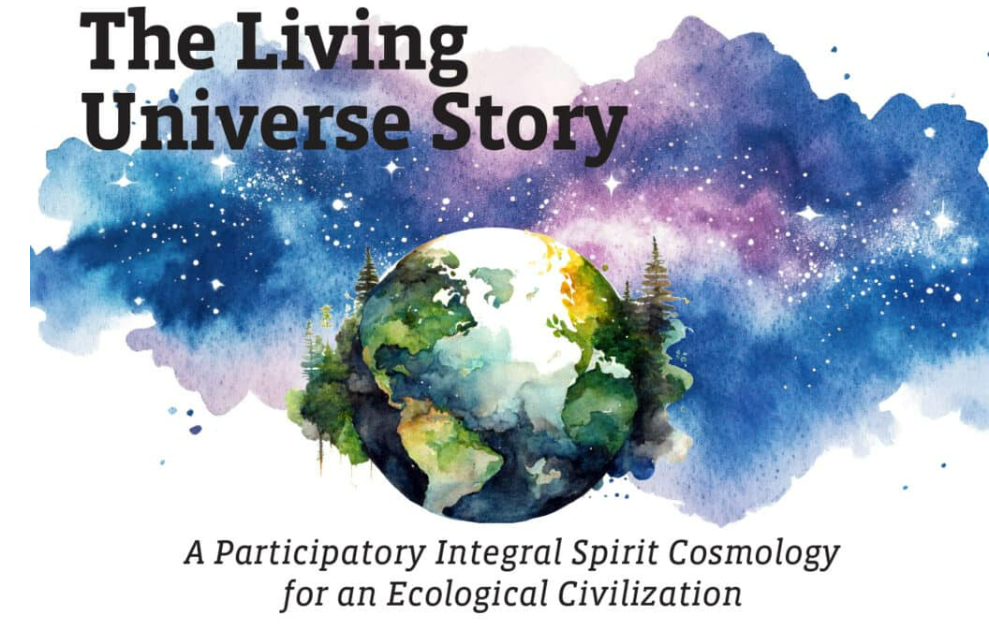
Read The Living Universe Story: A Participatory Integral Spirit Cosmology for an Ecological Civilization
Great to see that David is still active and creative, and that Thomas Berry’s vision is still alive in him and others, including myself.
The action and visionary writings of indefatigable David are admirable. His positive approach in tracing paths towards an Ecological Civilisation are stimulating and encouraging in these troubled times. Hope for the young generation!
From “When Corp Rule the World” until today David is breaking ground and rearranging my thinking! On p. 19 of this article, “The Living Universe Story,” I would add one more item where he says, “If the Economy is the circulation system of society, governance is the nervous system…” In “Blessed Unrest” (2007) Paul Hawken suggests that the Earth’s immune system is made up of the million or so organizations all around the globe that are working for social justice, the environment, and indigenous people’s rights. He suggests, as David would likely agree, that these decentralized, self-organizing groups are based on shared values and moving forward toward a more ecological civilization.