
Seeing beneath the surface: Climate justice and African youth
By Daniel Daruty de Grandpré, Programme Associate at The Club of Rome, and Mirriam Gurajena, Project Coordinator at The Sparks Impact Fellowship
30 April 2026

Africa contributes less than 4% of global greenhouse emissions, yet its youth live with the daily consequences of a crisis they did not create. Floods, droughts and food insecurity define not only landscapes but also futures. Across the continent, a generation is rising to reclaim climate justice, not as victims of crisis, but as agents of change.
This reflection draws on a systems mapping paper developed as part of the systems thinking module for the Sparks Impact Fellowship, where we sought to explore the dynamics shaping African youth within the climate justice landscape.
Beneath this visible activism lies an invisible architecture, a web of histories, ideologies and assumptions that shape who gets to lead, who gets to decide, and who gets to imagine Africa’s future. Systems thinking teaches us to pay attention to three dimensions of change: complexity, scale and depth. Complexity reminds us that problems are never isolated; inequality links to education, gender, policy and ecology. The scale shows that these dynamics stretch across chasms like geographies and institutions, often defying local fixes. And depth asks us to look inward, to the social norms, beliefs and power structures that sustain inequities.
For us to understand this, we must look beneath the surface.
The iceberg model
What is seen, the floods, the droughts, the policy meetings, is only the tip of the iceberg. Beneath these events lie the patterns: recurring financial dependency, cycles of debt and the maintained exclusion of African youth from decision-making spaces.
As we go deeper, the structures that hold those patterns in place, colonial legacies, extractive global economies and development frameworks that prioritise growth over care. And at the very base of the iceberg sit the mental models: the underlying paradigms that some know better, that progress must be measured in GDP and that Indigenous wisdom is a relic rather than a resource.
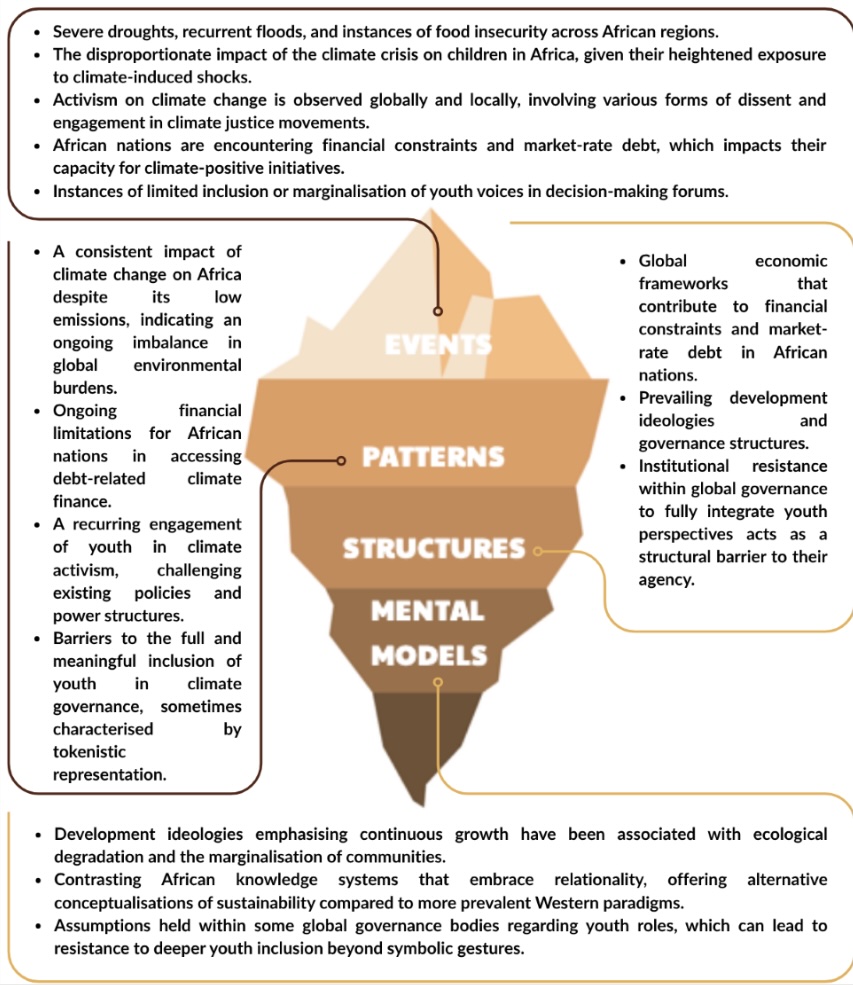
When we map Africa’s climate justice landscape through this lens, we see that the crisis is not merely environmental. It is epistemic and systemic; it is the result of centuries of ideas that have defined whose knowledge counts and whose future matters. Seeing beneath the surface means confronting the paradigms that normalise inequality, even within climate action itself.
Mapping youth agency
If the iceberg reveals depth and scale, the systems map reveals some of the complexity. Our micro systems map attempts to trace and understand how African youth fits within this landscape, and how social, economic and cultural forces interact in both contrasting, enabling and disabling ways.
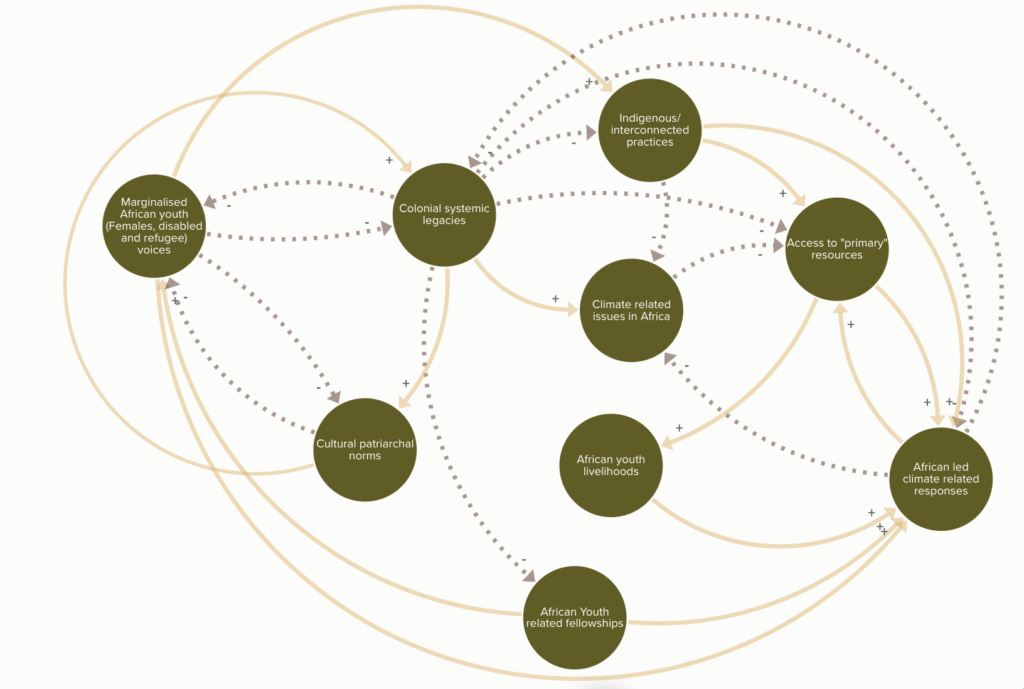
At one end of the map lie the reinforcing loops of marginalisation: colonial legacies that perpetuate inequity, patriarchal norms that silence young women and marginalised voices, and institutional resistance that tokenises participation rather than transforming it.
Yet the same system also holds seeds of change. Youth-led climate fellowships, Indigenous ecological practices and intergenerational movements appear as potential leverage points. Each fellowship that equips a young leader, each Indigenous practice that restores a relationship with land, weakens the logic of extraction and strengthens the logic of interconnection.
The map reminds us that youth leadership does not sit on the periphery, but rather, is fully embedded in the system.
Reimagining justice
Systems mapping is never finished. Each connection drawn reveals another waiting to be seen. What matters is not the perfection of the map, but the act of seeing differently, learning to recognise patterns of harm and patterns of possibility.
Climate justice in Africa, viewed through a systems lens, becomes not a single struggle but a living practice. It is interconnected and relational, built through youth who refuse to inherit only crisis and instead choose to inherit responsibility.
To see beneath the surface is to accept that the system is alive, shifting, interconnected and full of possibility. The work of African youth today is not merely to fix a broken system, but to reimagine the relationships that sustain it. Perhaps climate justice is not a final goal, but a rehearsal of futures rooted in both ancestral wisdom and emerging imagination.
So perhaps the system is asking us this question:
What might become possible if we learned to see differently, together?
This piece reflects on the contents of ‘Climate justice in Africa, a systems perspective’.

No comments yet