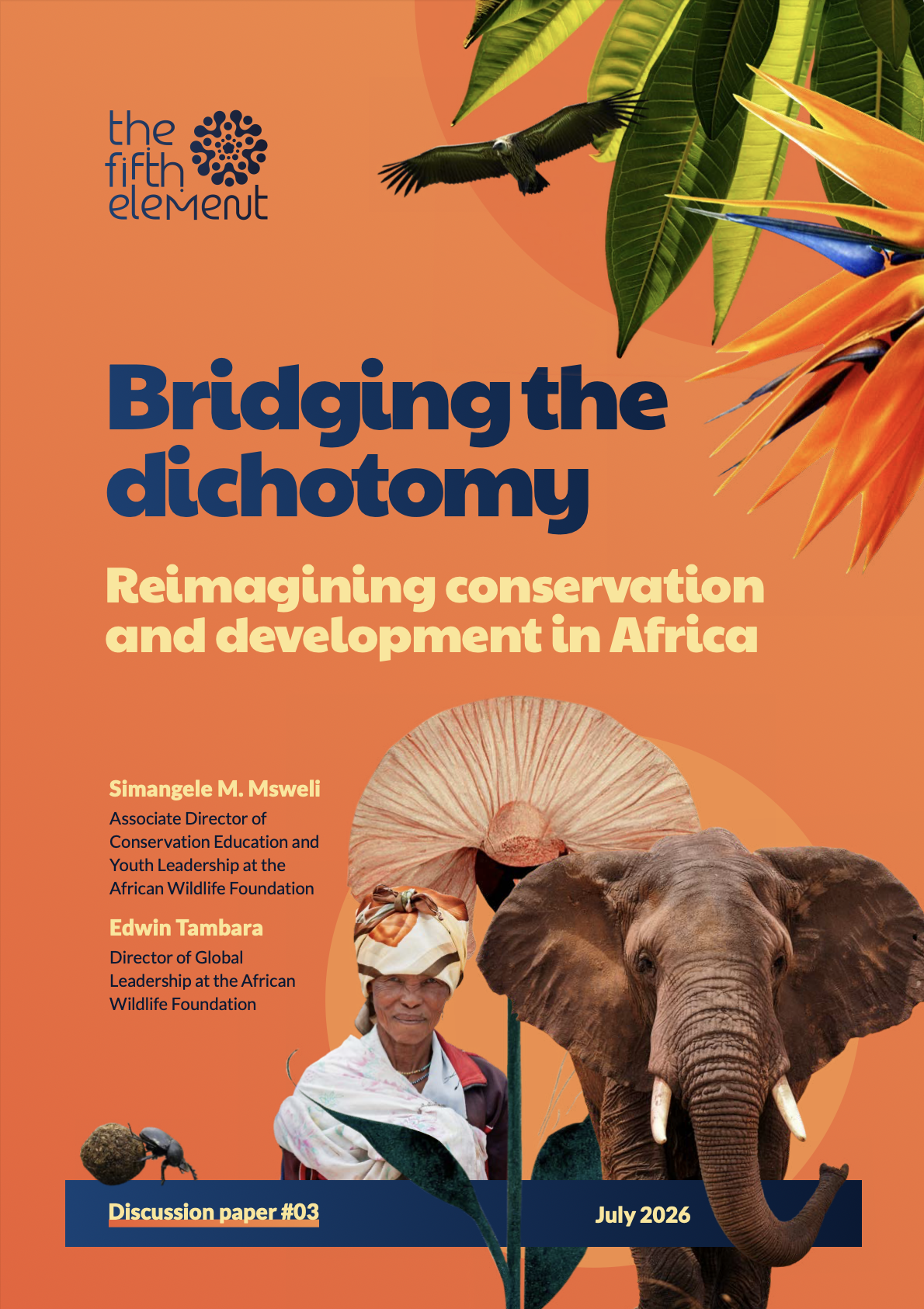
Bridging the dichotomy: Reimagining conservation and development in Africa
Published: 2026
Authors: Simangele M. Msweli, Associate Director of Conservation Education and Youth Leadership at the African Wildlife Foundation, and Edwin Tambara, Director of Global Leadership at the African Wildlife Foundation
For centuries, conservation in Africa has been framed as a contest between protecting nature and advancing human development. This discussion paper argues that the two are not opposing forces but a single, indivisible pursuit, one rooted in Africa’s own traditions of reciprocity, stewardship and belonging.
Rather than offering a single fix, the paper traces how colonial dispossession created this false dichotomy, and sets out seven axes, kinship, leadership, design, policy, finance, youth and governance, through which Africa can reunite conservation and development on its own terms.
Drawing on African philosophies from Ubuntu to Sankofa, the paper sets out seven axes for reuniting conservation and development:
• Kinship: Ubuntu and the ecology of belonging
Rooted in the maxim “I am because we are,” Ubuntu treats land, water and biodiversity as part of a shared moral community rather than as resources to exploit, restoring a relationship of belonging between people and nature.
• Leadership: communal leadership and the future of stewardship
Drawing on models such as Ghana’s community-led sacred groves and Ethiopia’s Borana water governance, this axis calls for conservation to be co-owned and African-led, rather than shaped by external prescriptions.
• Design: nature as foundational fabric for a resilient future
With 62% of Africa’s GDP dependent on nature’s services, this axis argues for placing ecosystems at the centre of planning, infrastructure and cities, rather than treating them as a constraint on development.
• Policy: reimagining global and national frameworks
This axis calls for African institutions and platforms to lead policymaking on their own terms, so that global frameworks reflect African priorities rather than externally funded agendas.
• Finance: financing transformation
The paper calls for conservation finance that recognises African communities as co-investors in global environmental outcomes, not recipients of charity, unlocking the continent’s biodiversity economies as an engine of inclusive growth.
• Youth: why young conservationists must lead political transformation
With a median age of under 20, Africa’s future depends on young people seeing themselves in conservation, economically, scientifically and emotionally, through institutionalised leadership rather than one-off initiatives.
• Governance: fixing the foundation on which conservation and development stand
Strong, accountable governance, illustrated by Kenya’s 2025 devolution of Amboseli National Park to Kajiado County, underpins every other axis, enabling communities to hold real authority over the landscapes they steward.
We hosted a webinar to reflect on the themes of the paper, take a look:
In 2025, The Fifth Element deepened partnerships, launched new initiatives and moved from exploration to impact. From intergenerational leadership and African epistemologies to regenerative enterprises and global youth engagement, our work continued to catalyse the...
From quantum interconnectedness to repeating patterns across nature, growing evidence points toward a deeply interconnected cosmos. The paper also explores how the universe evolves through increasing complexity, from stars and planets to life and ecosystems. Rather...
How to Get Things Done is designed to empower young people everywhere to transform the world around them. The toolkit is the result of a collaboration between Responsible Project Management and The 50 Percent, and serves as a companion to the Young person’s guide...