
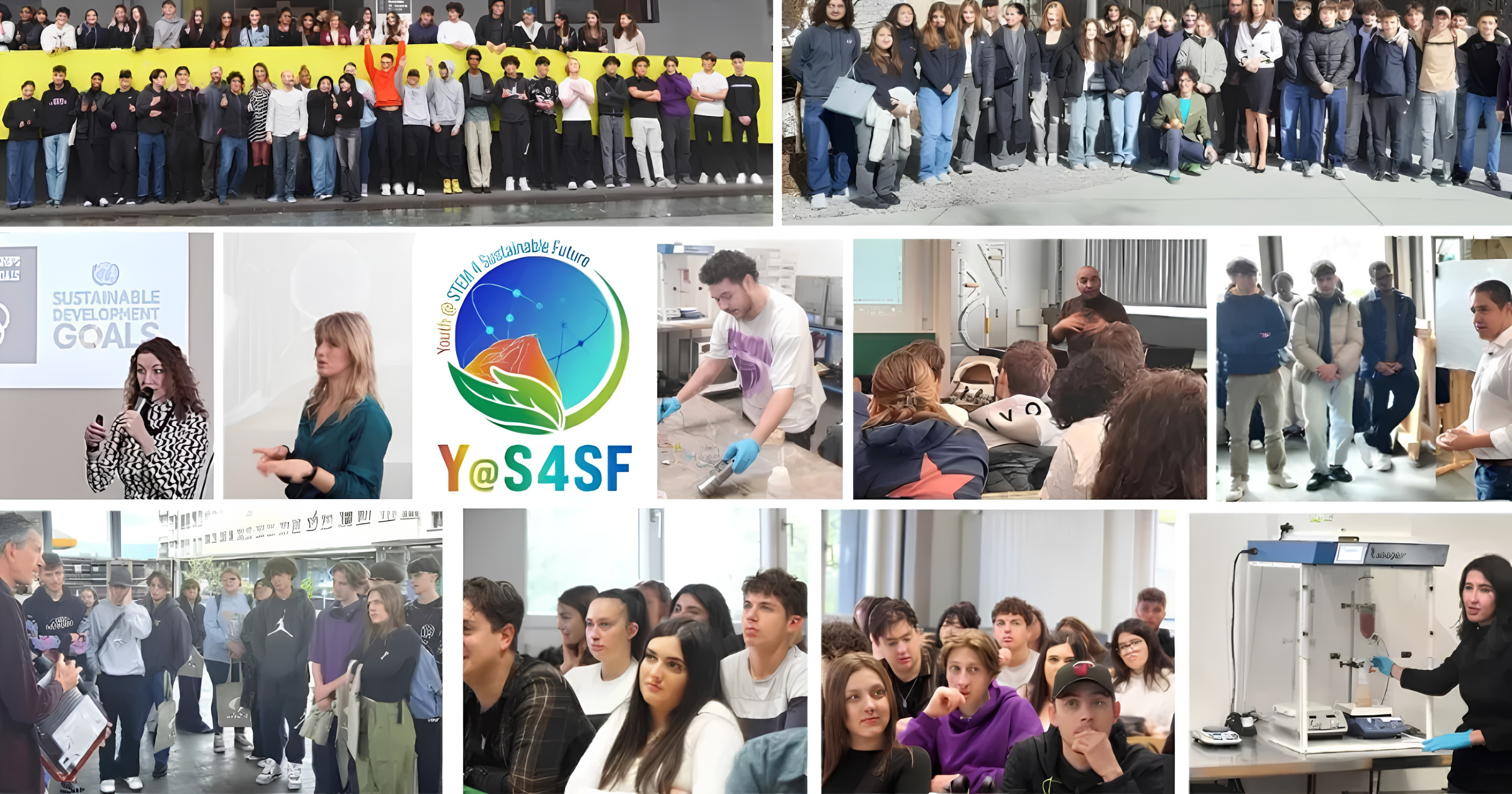
Since 2025, Earth-Humanity Coalition and Science for Sustainable Future have been working on a joint programme named ‘EHC-S4SF programme of Science and Education for Society and Sustainable Future’, exploring how science can serve as a unifying force for sustainability, education and global cooperation.
Our partner, Science for Sustainable Future (S4SF) is a non-governmental organisation established in 2024 in Geneva. Its integral goal is to create a platform for dialogues between present and future science and society leaders, all relevant stakeholders of the international innovation ecosystem, and other interested actors at the international scale to foster scientific awareness and promote science-based decision-making for a sustainable future. The Head of the Programme is Barbora Bruant Gulejova, Founder and President of S4SF (more details in this article).
What we have been up to:
Youth at STEM for sustainable future
Aligned with Earth-Humanity Coalition’s work on ‘Promotion of Transdisciplinary Practices in Education’, the EHC-S4SF programme leads the pioneering and groundbreaking initiative Youth@STEM4SF (Youth at STEM for Sustainable Future), aiming to shape STEM education at high- and even primary-school level. This innovative programme aims to inspire talented girls and boys to pursue STEM-related careers and to cultivate a new generation of future society leaders who are scientifically aware, responsible citizens and decision-makers. Through real-world context, transdisciplinary collaboration and engagement with experts from research, academia and industry, students dive into the innovation ecosystem and, in the second step – Youth@STEM4SF competition – they become co-creators of new educational resources that link science with societal impact and sustainability.
The programme has been officially recognised by Swiss educational authorities for its alignment with the new federal education plan and its relevance for transversal competencies, SDG integration and informed career orientation. In addition, in May 2025, the project was selected to be presented at the general assembly of the Swiss National Conference of gymnasium directors. During the International Decade of Sciences for Sustainable Development, the successful Swiss pilot and proof of concept is planned to be extended to other countries across Europe and beyond. The first pilot beyond Switzerland has already been realised with IUPAP as pre-event of Big Science Business Forum 2024 in Trieste. Strategic relevance of this approach of integration of innovation ecosystem actors in shaping the education, is described in the article in the European Physics News.
The video below presents testimonials from teachers, students, scientists and industries. Take a look!
Big Science model for global societal challenges
Aligned with Earth-Humanity Coalition’s work for ‘Development of Sciences for Planetary Reconciliation’, the programme promotes the Big Science model as a proven paradigm for addressing global societal challenges through peaceful international cooperation and shared research infrastructures. This model – highlighted in an article in European Physics News – emphasises how scientific collaboration can transcend geopolitical divides and advance sustainability, peace and security.
In parallel, the programme is creating a platform for strategic dialogue among current society leaders – scientists, policymakers, industries and investors – on emerging technologies with societal relevance.
A first example of this was the high-level discussion on the commercial era of nuclear fusion, co-organised with the Swiss Academy of Technical Sciences (SATW) and EPFL in December 2024. The event gathered 14 key players from the global fusion ecosystem to explore how science diplomacy and coordinated strategies can accelerate the commercial and sustainable future of fusion energy.
Through these complementary tracks – education and policy dialogue – the EHC-S4SF programme contributes directly to the UN International Decade of Sciences for Sustainable Development (2024–2033) and supports the realisation of the Sustainable Development Goals (SDGs).