
The missing ingredient
By Marisa Toldo, architect, founder of Porto Dome
10 August 2026
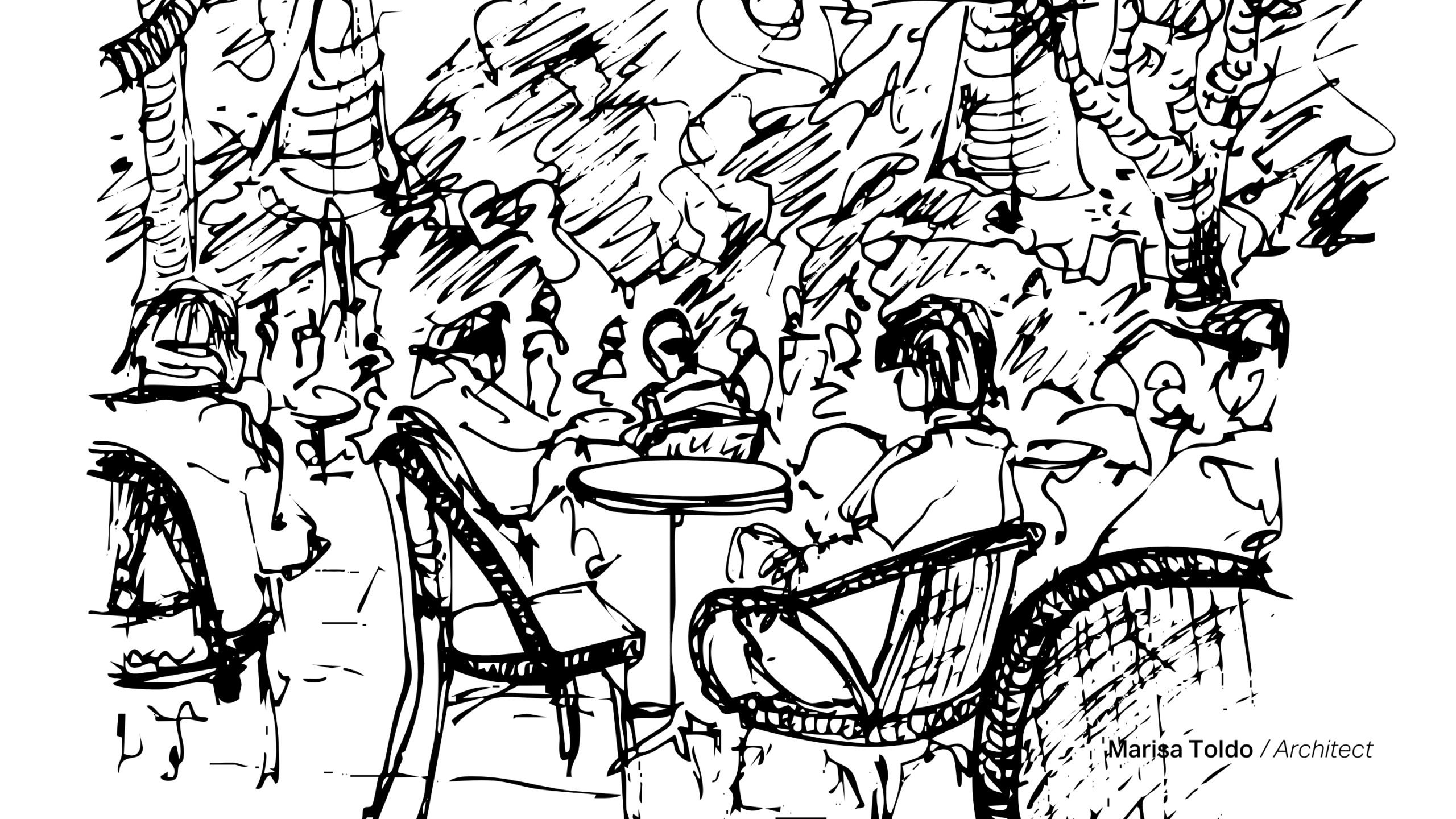
© Marisa Toldo, 2025. All rights reserved. Handmade sketches by the author. Original drawings, ink on paper
There is a design flaw at the heart of modern society and as an architect, I can name it precisely: we have built a world that keeps people who need each other apart, and then we hire specialists to manage the damage.
One in six. One hundred lives an hour.
According to the WHO Commission on Social Connection’s 2025 report, one in six people worldwide is experiencing loneliness, linked to an estimated 871,000 deaths every year. Not from violence or disease in the conventional sense. From disconnection. From the simple, devastating absence of each other.
Youth mental health is collapsing. Dementia care is bankrupting families and health systems at the same time. Civic trust is dissolving. We treat each of these as a separate problem, with a separate budget and a separate task force. But what if they share a root cause we have been too uncomfortable to name?
What if the missing ingredient is each other, specifically across generations?
We are mammals. Community is not optional.
This is not a modern pathology, and no app will cure it. We regulate each other’s nervous systems. We learn through proximity. We grieve in company. The neuroscientist John Cacioppo spent decades demonstrating that chronic loneliness is physiologically destructive, accelerating cognitive decline, suppressing immune function, shortening life.
The question is not whether we need each other. We do. The question is who we expect to carry the weight of that need. For most of recorded history, and still today, the answer has been: women. Quietly. Unpaid. In Britain alone, informal carers, predominantly female, contribute an estimated £162 billion in unpaid care every year, approaching the entire NHS budget. The care that holds communities together has been treated as a private arrangement rather than a public infrastructure. That has never been an oversight. It has been a policy choice, made for the most part by people who were not doing the caring.
Changing that is not only a gender argument. It is a civilisational one.
We have built age segregation. We did not drift into it.
I trained as an architect. For years I designed spaces for people, and for years I watched those spaces work against exactly what people needed most. Care homes at the edges of cities. Student housing sealed off from everything else. Play areas and retirement benches placed at opposite ends of the same park, as if a child and an old man catching each other’s eye were an error to be corrected.
The research is unambiguous: intergenerational contact reduces loneliness in older adults, improves outcomes for children and builds civic trust. This evidence has accumulated for decades. And yet our spaces, our funding and our planning continue to be designed as if generations are better off apart.
Good intentions are not a system.
There are brilliant intergenerational programmes running across the world: shared-site care homes, learning hubs, housing schemes that weave students and older residents into the same building. I have visited some of them. I have seen what they produce.
Most will disappear.
Not because conviction runs out, but because intergenerational practice has been built on goodwill, individual champions and short-term funding cycles, not on infrastructure. When the champion moves on, the programme ends. When the grant runs out, the space reverts.
This is how progressive ideas die: not in confrontation, but in administration.
Every other dimension of built quality has a standard. Accessibility. Fire safety. Energy performance. These exist, and because they exist, they shift behaviour at scale. Intergenerational design has no equivalent. Nobody is held accountable for building a care home that isolates its residents. The absence of connection is, legally and financially, consequence-free. UK evidence already shows intergenerational practice generates a social return of £6.97 for every £1 spent, an infrastructure argument, and it deserves to be treated as one. As the Club of Rome has long argued, transformative change requires changing the rules of the game, not just the players.
Changing the rules — not the goodwill, not the players, but the rules themselves — is what systems transformation actually requires. And intergenerational design has not yet demanded it.
One afternoon in a courtyard in northern Italy.
My father was living with dementia in a care home. One afternoon, sitting in the courtyard, he caught the eye of a four-year-old girl playing on a swing nearby. Something passed between them, a gaze that unfolded into a shared, unhurried smile. Care was not flowing only from the healthy to the ill, or from young to old. It moved in both directions. The child brought her vitality. My father offered recognition, and something that looked very much like joy.
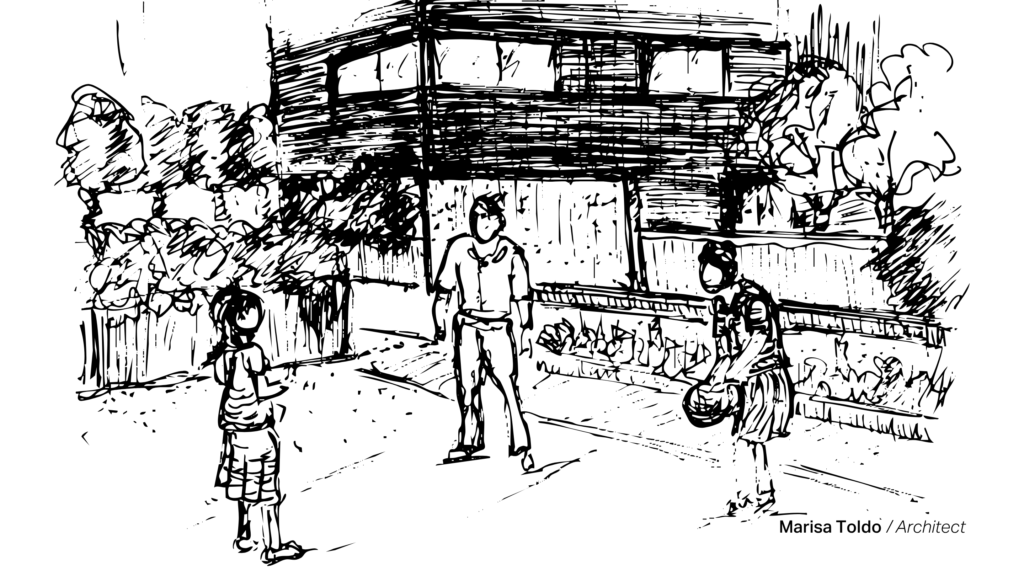
That moment was not a programme. It was not funded. It happened because someone had designed a courtyard where a child and an old man could simply be in the same place.
That is the whole argument.
Who is going to build the infrastructure that makes moments like that impossible to leave to chance? Infrastructure that distributes the work of care across institutions, genders and generations, rather than concentrating it, as it always has been, in the same exhausted hands.
Not fund a programme. Not publish a report. Build the infrastructure.
Because if we do not answer that now, we will be having this same conversation in 20 years, with better data, more ministers and the same missing ingredient.

No comments yet