
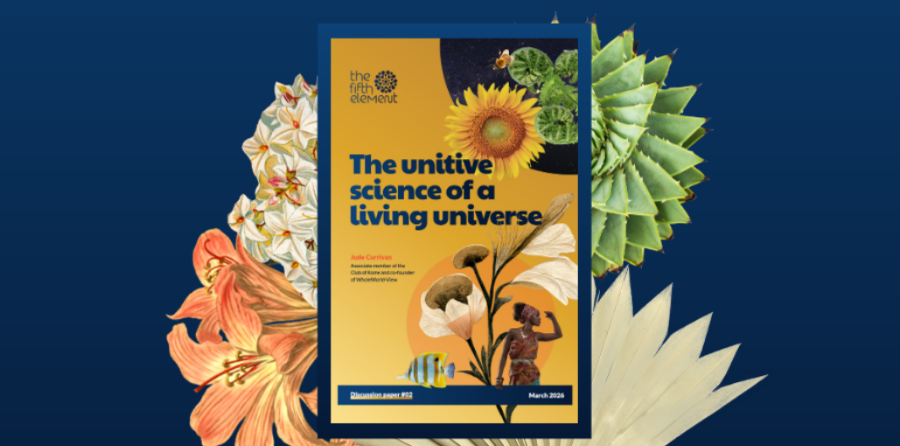
A new discussion paper: The unitive science of a living universe
By Jude Currivan, Associate member of the Club of Rome and co-founder of WholeWorld-View
17 March 2026
What if our prevalent science-based worldview rooted in materialism and separation, could be about to be turned upside down? What then for our world?
Science plays a central role in shaping our collective future, a conviction reflected in the 2024 launch of the International Decade of Sciences for Sustainable Development (IDSSD) initiative. Led by UNESCO, the initiative aims to ‘promote global collaboration through sciences to achieve a sustainable future’.
Yet while its technological progress has brought substantial benefits, the prevailing scientific perspective has framed our universe and the nature of reality as a solely material and mechanistic system, without inherent meaning or purpose. These assumptions and the limited evidence then available helped underpin the Industrial Revolution in the 19th century. Fuelling not only an extractivist and exploitative economic and financial system but the governance, social and corporate systems and structures that, reflected and embedded its imperatives, continue to drive today’s social and ecological crises.
This worldview and its consequences have also effectively dis-membered our collective psyche, giving rise to what I refer to as a dis-ease of separation in how we relate to each other and the natural world. To truly confront the existential threats we face, we must do more than manage the symptoms of its pathology; we must heal our foundational rupture.
The Club of Rome has long appreciated that systemic transformation must begin with a transformation of worldview. As for example was noted in recent reflections on peace and planetary wellbeing (more here) which suggest that lasting solutions must address not only geopolitical tensions, but also the deeper patterns of disconnection that drive them.
Now, new scientific discoveries are indeed revealing such a wholistic understanding. The Fifth Element’s latest discussion paper, ‘The unitive science of a living universe’ summarises the wide-ranging evidence at all scales of existence and across many fields of research that supports and enables an emergent perspective: that our universe is fundamentally relational and interconnected.
Here are the key findings:
- The same patterns shape everything — from atoms to the universe
From tiny clusters of atoms to the faint background radiation left over from an early epoch of the universe, the same basic patterns appear again and again. These patterns are not random. They show that reality is built on relationships — how things connect and interact — rather than on separate, isolated objects.
The paper suggests that what we call matter may be better understood as organised information: patterns that take physical form. These relational patterns are not only found in distant galaxies or subatomic particles, but also in the systems that shape our everyday lives. - Nature and human systems follow similar mathematical patterns
The same repeating shapes and growth patterns appear across very different systems. Scientists call some of these fractal patterns — structures that look similar at different scales, like branching trees, river networks or blood vessels.
Many systems also follow power laws. This means that small events are common and large ones are rare, but they follow a predictable relationship. For example: earthquakes range from many small tremors to a few major quakes, conflicts range from small disputes to large wars, cities and galaxies both show patterns in how populations cluster and grow, and ecosystems and even the internet develop networks with similar structures.
Across nature and human society, similar organising principles are being discovered to be at work. - The universe is connected at a deep level
Einstein’s theory of relativity shows that nothing can travel faster than the speed of light within space-time, preserving cause and effect across the universe.
At the same time, experiments in quantum physics demonstrate that particles can remain connected across vast distances — a phenomenon known as quantum entanglement. This means two particles can behave as if linked, even when separated.
Experiments confirmed this effect over increasingly large distances, and the 2022 Nobel Prize in Physics recognised this work. Together, these findings suggest that the universe is not composed of completely separate parts, but behaves as a deeply interconnected whole.
Crucially, while going beyond materialism per se, such a unitive understanding that sees our universe as essentially whole, fundamentally relational and interdependent continues to be scientifically accessible and rigorous. Rather than discarding previous scientific frameworks, it includes and transcends the previous paradigm; now, though, while exploring whether mind and consciousness may play a more fundamental role in the nature of reality.
Its unitive vision and narrative converge with ancient wisdom teachings and Indigenous traditions, re-imbuing our universe with innate meaning and purpose and ourselves in mind, body and spirit, inseparable from its planetary and universal web of life.
The paper invites further dialogue, investigation and testing of such an evidence-based unitive perspective, aiming to further enable and empower our collective efforts regarding human and planetary well-being.
In positing that such reframing of our worldview offers a potentially pivotal opportunity to usher in our next and evolutionary steps as a species, it raises and invites exploration of important questions, ranging from the personal and cultural across organisational and societal levels to global and planetary systemic scales.
For example:
- How might a unitive perspective inform approaches to reconciliation, peace-building and healing social fragmentation? And what could it mean to design education and learning systems that reflect interdependence, planetary limits and long-term responsibility?
- How might this perspective contribute to new ways of thinking about governance in a pluralistic and interdependent world? And what questions does it raise about how we shape economic systems, technological innovation and artificial intelligence in ways that serve long-term planetary wellbeing?
- In what ways could its perspective help re-contextualise today’s overlapping meta-crisis not only as breakdowns, but also as moments of potential transformation, or even a metamorphosis?
- Also, as we seek to navigate these turbulent times of transition, how might understanding humanity as part of a living Earth system and interdependent universe influence what it means to be a good ancestor in nurturing our emergent potential?
As Donella Meadows, co-author of the first report to the Club of Rome’s The Limits to Growth, argued, such a change of mindset may be the most effective intervention to guide and empower democratic and equitable responses to existential risks that we face, and to support the pathways to a regenerative and sustainable future for humanity and our planetary home.
Read the full discussion paper ‘The unitive science of a living universe’ here, and share your thoughts below.
Jude Currivan is the leading visionary of our time in the “wholistic” understanding of our universe. Her work serves as a template for the jigzaw puzzle of reality. This article and the questions posed are worthy of everyone’s attention if we are willing to take the next steps in our evolution.
Dear Pedro, many thanks. The evidence presented in the paper and the questions it raises are for me the most important of our times and if as you write, we are willing to consider them, offer next steps in our evolution. Warmly, Jude
In ecstatic agreement with Pedro Carta’s comment, knowing Jude as a preeminent force of the deepest understandings – from every ‘way of knowing’ – of the mysteries and realities of our magnificent, beautiful, and ultimately loving Cosmos. Our Universe, best experienced with music – not simply a metaphor but as a creative, vibrational, trans-rational mode of expression and shared existence.
This is a timely intervention and Jude Currivan highlights many fascinating and relevant aspects of contemporary cosmology. I am especially drawn to her reference to the role of ‘information’ as an essential component of the universe.
I am not a scientist but have a specific interest in this work through my study of the philosophy of Michel Serres (still terribly neglected in this field). To quote from the paper, Serres (1930-2019) spent his whole career and explored in over 70 books the bridging of:
“domains that have been artificially separated, offering a cosmological framing that supports deeper learning, ethical responsibility and renewed possibilities for human and planetary wellbeing within an interconnected universe.”
I am not sure if this is the best platform, but I have one general and one specific question to raise directly with the author, if may. It seems you make some huge steps from summarising “emergent evidence-based unitive understanding of the nature of our universe” to “revealing a cosmology of existentially meaningful and evolutionary purposeful universal consciousness.” The assumption, I think, rather than evidence, poses an “inherent integration” and “innate meaning and purpose” in the universe. In this context, I am not sure what “biological emergence as expressions of an evolving universe that in its entirety is essentially ‘living’” means. Is the author suggesting that amongst the scattering of 2 trillion galaxies, the evolution here on this spec of a planet has a universal wider meaning? Perhaps. It’s definitely puzzling how the working of symbiosis began, how Gaia formed. But can we be certain? I am not convinced by the evidence. Your paper comes across in this respect as human-centred, as if evolution over 13 billion years was always heading this way.
My specific question concerns the statement: ‘This unitive perspective also removes any need for the notion of negentropy or syntropy, as a sort of reversal of universal entropic flow in open sub-systems, such as a planet or a biological organism, which exist far from states of equilibrium’. I have an interest in the work of Ilya Prigogine and, although since his research into dissipative systems has been overtaken and moved in many different directions in recent decades, I still find his general points about irreversible time cutting across different layers of the universe inspiring. Could you clarify what you meant? In what sense ‘removes’?
I hope this comment is taken in a spirit of seeking understanding.
Dear Peter, many thanks for your comments. In such a relatively short paper, I was only able to summarise the framing and evidence for a posited inherently meaningful and evolutionary purposeful Universe. This is expanded significantly in my two books: The Cosmic Hologram: In-formation at the Center of Creation (Inner Traditions 2017) and The Story of Gaia: The Big breath and the Evolutionary Journey of Our Conscious Planet (Inner Traditions 2022).
These also go into much more detail regarding the underlying nature of information and especially meaningful in-formation.
The paper addresses entropy as the energetic microstates of a system and in expanding to intropy as the information content of a system. It then posits a universal arc over time, rather than from order to disorder, from simplicity to complexity. This also in dissipative sub-systems such as planets, form informationally individuated and coherent environments for further complexity to evolve – and so without a need to somehow reverse ‘disorder’ through a notion of negentropy.
I hope this is helpful.
Warmly, Jude