
Holding course
By Alexandre Gagnon, Climate adaptation and resilience specialist at Ouranos
18 February 2026
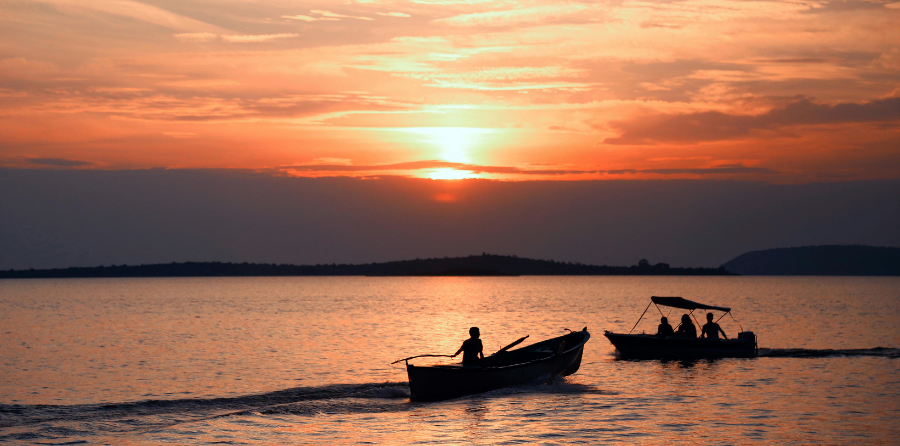
Credit: Pexels
To be a researcher is to learn how to navigate the complexity of the real world.
It means tracing new routes, venturing into the unknown and sharing discoveries along the way.
It also means facing headwinds: the pull of simplification, the comfort of rigid models and the self-imposed limits that can shrink the vast ocean of knowledge into a shallow pool.
Yet in this age of polycrises, science must play a vital role: helping humanity stay its course toward the common good.
Today’s challenges demand a renewed gaze, new postures and the courage to ask difficult questions.
Researchers must dare to explore the ocean of knowledge and venture beyond mapped waters.
To do so, they must learn to:
- Go further
- Broaden the horizon
- Gain altitude
- Face the storm
Go further
The diagnoses keep accumulating, and the dangers are clear: rising greenhouse gas emissions, increasing temperatures, biodiversity collapse, deepening social inequalities, among others.
But knowing where the reefs are is not enough to avoid them.
Going further means recognising the obstacles, activating levers of change and supporting real transitions.
Initiatives like Drawdown Explorer, which turn global data into actionable pathways, show the way. Built on rigorous analysis, this tool identifies practical solutions to reduce greenhouse gas emissions and explains how to implement them.
Breaking through the wall of findings means understanding that research can be a propelling force, not merely a mirror reflecting reality.
Broaden the horizon
On a ship, there are no passengers: everyone helps steer.
Yet science has long isolated itself, cut off from the deck where other forms of knowledge and voices keep the vessel moving.
To broaden the horizon is to embrace multiple perspectives, bridge disciplines and invite in the knowledge systems and communities too long excluded. The principle of Two-Eyed Seeing / Etuaptmumk, articulated by Murdena Marshall, Albert Marshall, and Cheryl Bartlett, embodies this openness.
It calls for a respectful and shared application of Indigenous and Western ways of knowing, building knowledge from each other’s strengths, learning together and thinking for the next seven generations. Such an approach asks researchers to step out of their comfort zones and weave new relationships. It may mean letting go of some control over methods or outcomes, but it brings greater relevance, legitimacy and meaning in return.
Gain altitude
From the top of the mast, one sees not only farther but also more clearly.
To gain altitude is to restore coherence, connect the dots, question one’s biases and bring hidden patterns into view. Organisations like IPBES, through reports such as those on the Nexus approach or Transformative Change, embody this systemic vision of integrated science.
It is also about daring to speak from higher ground. From that vantage point, IPBES has named what lies beneath the waves: the disconnection of individuals from nature and the domination of nature and other individuals, the inequitable concentration of power and wealth and the prioritisation of short-term individual and material gains.
While recognising that science does not hold all the answers, it can illuminate possible pathways, provided it keeps a wide view of our shared landscape.
Face the storm
On planet Earth, the wind sometimes rises without warning. The waves deepen, the sky darkens and the sea grows demanding.
Contemporary research sails through these same turbulent waters, torn between the need to observe the deep currents shaping our world and the urgency to act before the storm intensifies.
Assailed by the relentless logic of publish or perish, many researchers struggle to find time to go further, broaden the horizon or gain altitude.
Yet some questions require time, patience and the courage to resist haste. Still, the storm does not calm. The window for action is narrowing, especially under the pressures of the climate emergency.
This demand to produce, to find and to act deepens the tension between knowledge and action and reopens the question of the researcher’s role and responsibility.
In this context, some choose to face the waves rather than flee them. Movements such as Scientist Rebellion and the Union of Concerned Scientists encourage researchers to step beyond the lab, to speak out and to engage differently.
To face the storm is to accept that science can neither wait for perfect calm nor allow itself to be engulfed. It means embracing imbalance, meeting the headwinds and continuing the crossing.
Holding the course toward the common good
Researchers are called to chart new passages and push back the boundaries of the ocean of knowledge, despite uncertainty and pressure.
This posture requires more than technical skill: it calls for courage, imagination and an unwavering commitment to a shared and living common good.
It also means daring:
Daring to go further and move from diagnosis to action.
Daring to broaden the horizon for inclusive, shared knowledge.
Daring to gain altitude to see the whole picture.
Daring to face the storm.
Together, let us explore the ocean of knowledge and hold the course toward the common good.
No comments yet