
Rethinking environmentalism: Why African ways of knowing matter more than ever
By Raad Sharar, Programme Lead at The Club of Rome
11 December 2025
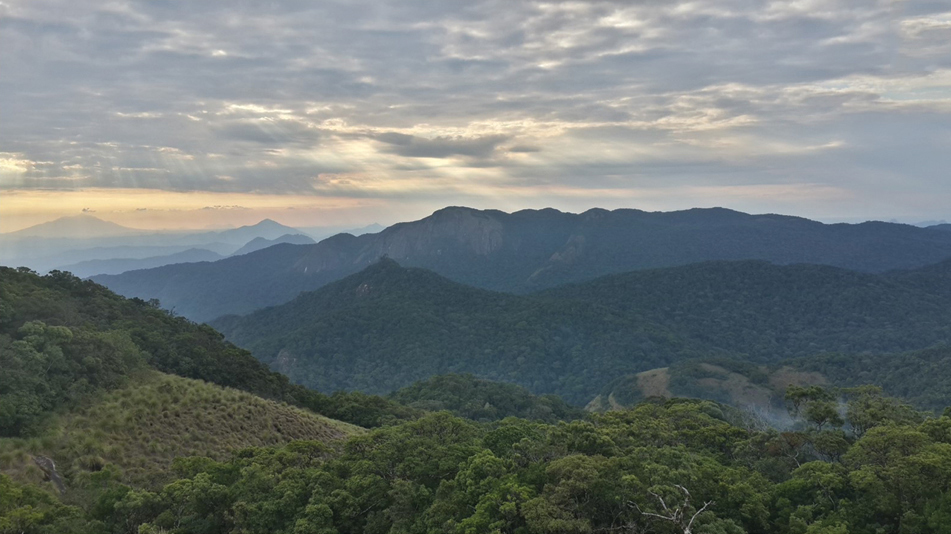
Mount Nabu, Credit: Conradie W, Bittencourt-Silva GB, Engelbrecht HM, Loader SP, Menegon M, Nanvonamuquitxo C, Scott M, Tolley KA.
For decades, global conversations about climate change and conservation have been dominated by a particular worldview. A worldview that draws sharp lines between humans and nature, between society and environment, between land and people. This worldview has shaped everything from scientific research to conservation practices and even the way universities teach environmental studies.
But across Africa, scholars, activists and communities are offering something radically different. They are reminding us that environmentalism is about culture, memory, identity and the deep relationships people form with the places they inhabit.
The Fifth Element in partnership with Environmental Humanities South (University of Cape Town) has launched ‘Africa, climate and education’, a seminar series to bring these conversations to life. The first conversation which took place at the Jena Declaration Conference for Africa 2025 highlighted the work of Hugo Canham and Anselmo Matusse. Their stories, grounded in African landscapes and lived experiences, push us to rethink what environmentalism can and must become.
Here are some key highlights from the webinar:
When “discovery” erases the people who were always there
One of the most striking stories shared in the webinar comes from Mount Mabu in Mozambique. For years, Western scientists and media outlets described the mountain as a “lost Eden,” a place “discovered” on Google Earth by botanists from London. Articles celebrated the pristine landscape and the biodiversity hotspot that had supposedly gone unnoticed.
Local communities had lived with, cared for, and governed the mountain for generations. They had sought refuge on it during Mozambique’s civil war, performed rituals there and understood it as part of a sacred network of landscapes. The mountain was not just wilderness. It was home, history, memory and governance. And yet, none of this appeared in the global conservation narrative.
Anselmo Matusse described how locals would tell him, “You must speak to the chief before going to the mountain.” Embedded in this simple instruction is an entire system of ecological governance, one that conservation NGOs often ignore or override. When conservation treats communities as obstacles rather than partners, it creates tension, mistrust and ultimately, ineffective environmental outcomes.
Land lives in us too
Hugo Canham’s work draws on similar themes, especially the deep entanglement of people and land. In many African contexts, land is not simply property or resource; it is a moral subject, an ancestor, a source of dignity and rootedness.
This stands in stark contrast to colonial conservation models that push local people off their land “for the greater good” or in the name of national development. It also challenges the idea that nature is an external object, a separate domain to be studied apart from human experience. When land and people are understood as interconnected, environmental care becomes relational rather than extractive. Stewardship becomes generational, tied to ancestors and future descendants. And environmental justice becomes inseparable from social justice.
The classroom as a site of possibility
One of the central questions raised in the webinar was: How do we teach this? How do we bring these indigenous ways of understanding land into universities built on colonial foundations?
Both speakers acknowledged the difficulty. Most African university systems still divide knowledge into rigid silos. Natural sciences here, social sciences there. Students are taught to analyse soil chemistry but not the stories communities hold about soil. They learn biodiversity taxonomy but not how people read the landscape through spiritual or ancestral relationships.
Yet the classroom continues to hold the promise of a different kind of learning. Canham and Matusse advocate for teaching through:
- Storytelling, especially intergenerational storytelling that brings ancestors, water, animals and land into the narrative as characters.
- Local experience, valuing students’ own relationships to land and bringing them into dialogue with formal environmental science.
- Embodied knowledge, recognising that learning is not only cognitive but emotional, sensory and communal.
- Decentring the human, challenging the idea that nature is something that “surrounds” us rather than something we are part of.
When students learn to see themselves as inseparable from their landscapes, they begin to question the universal models that dominate global climate discussions.
Local knowledge is not backward, it is a blueprint
A powerful example came from Matusse’s discussion of soil degradation. Drawing on the early scientific work of revolutionary thinker Amilcar Cabral, he noted that soil erosion in various societies was directly linked to their agrarian structures. Where land became privatised and commodified, soil degraded faster. Where communities practiced fallow agriculture, soil regenerated.
Indigenous ecological knowledge is not nostalgic but rather practical, tested and deeply attuned to local conditions.
A call for localism without parochialism
As the discussion drew to a close, the speakers emphasised that the future of environmentalism depends on returning to local knowledge, not in a narrow, exclusionary way, but in a grounded and relational one. Environmental action must be shaped by the people who know the land, who read its signs, who remember its histories and who carry its future.
With a hint of irony, Lesley Green, Co-Director of Environmental Humanities South and the moderator for the conversation pointed out that capitalism already treats a company as a legal person. If that is considered rational, why should it be irrational to treat land, rivers, mountains or ancestors as subjects with moral significance?
What these conversations ultimately reveal is that African environmentalism is not only a regional perspective, but also a different paradigm of life. It challenges the modernist separation of humans from nature and instead centres relationship, reciprocity and dignity.
As The Fifth Element reminds us, real transformation begins not with new technologies or policies, but with deeper learning: the courage to question the worldviews we take for granted and to “dance with paradigms” rather than cling to a single one.
African cosmologies, with their emphasis on ancestry, land as moral subject and pluriversality, offer precisely the kind of relational wisdom needed to bridge the “human gap” (the distance between our power to change the world and our ability to understand those changes). In a moment when global frameworks feel fragmented and overwhelmed, African ways of knowing remind us that hope grows from relationship: from listening to the land, honouring the stories that shape us and recognising that wellbeing emerges within the web of life, not outside it. This is more than environmentalism, it is an invitation to participate in Earth–humanity reconciliation with humility, curiosity and renewed imagination.
Rewatch the webinar:
No comments yet