
The inner shift: a journey to global change
By Kiyoshi Akasu, Soka Gakkai International Peace Center
25 September 2026
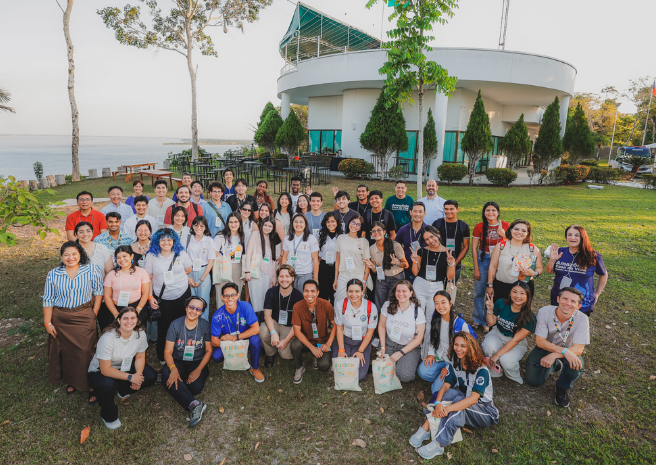
Amazonian Youth Summit in Brazil. Credit: Brasil Seikyo.
In an era increasingly dominated by runaway artificial intelligence and escalating geopolitical conflicts, it is easy to feel as though the world is spinning entirely out of our control. We often look to new technologies or massive systemic overhauls to save us. Yet, my work at the SGI Peace Center has led me to a different conclusion: that our external crises—whether ecological or technological—are ultimately reflections of human values. Therefore, if human beings themselves can change from within, there is no global crisis we cannot overcome.
I felt the truth of this last year during an intergenerational dialogue event we co-hosted with the Club of Rome and The Fifth Element at Taplow Court near London. Hearing the reflections of the young participants brought home to me how a single conversation or event can spark a lifelong shift in an individual. One youth eloquently shared that as they discussed the inseparable link between the self, others and nature, it became clear that this inner change—what we call the “human revolution”—is not merely a philosophy but a living practice of humility and courage. They noted that true leadership and activism are not acts of external power but acts of consciousness: a call to transform the systems within ourselves that mirror the inequities and disconnections we see globally.
This profound inner transformation is the prerequisite for human survival, a shared understanding that has brought together the Club of Rome and the Soka Gakkai at several key moments over the past half century. Today that shared understanding is carried forward through The Fifth Element, the Club of Rome’s programme for catalysing the emergence of a human revolution, the natural meeting point for our two traditions.
The roots of our shared vision
This partnership began not in a sterile boardroom, but under the bright blue skies of Paris in May 1975. The Club of Rome co-founding president, Aurelio Peccei, and the president of Soka Gakkai International, Daisaku Ikeda, chose to bypass a formal reception room to sit outside in the garden of our Buddhist centre there. In that unpretentious “outdoor salon”, a visionary dialogue took root.
They both recognised that addressing the physical limits of our planet required addressing the spiritual limits of humanity. In their published dialogue, Before It Is Too Late, they agreed that an inner transformation, or human revolution, must be a central ingredient in any recipe for change. Daisaku Ikeda articulated this as follows: “Humanity’s most pressing task today is the elevation and reformation of their inner spiritual life. This is what I call the human revolution,” and Aurelio Peccei stated, “the primary goal of the human revolution, and by far the most important outcome to be expected from it, is the full development of our innermost capacities.”
Their exchange culminated in a joint call to collective action: “On the issue of peace, we demand that you join us… if you want to join us in the struggle for peace, we could hope for no better reward for our labours.”

A legacy of responsibility and youth
After Peccei’s passing, this connection was carried forward by the Club of Rome President Ricardo Díez-Hochleitner. Considering himself a disciple of Peccei, he was determined to inherit the Club of Rome’s mission. He also continued a friendship with President Ikeda.
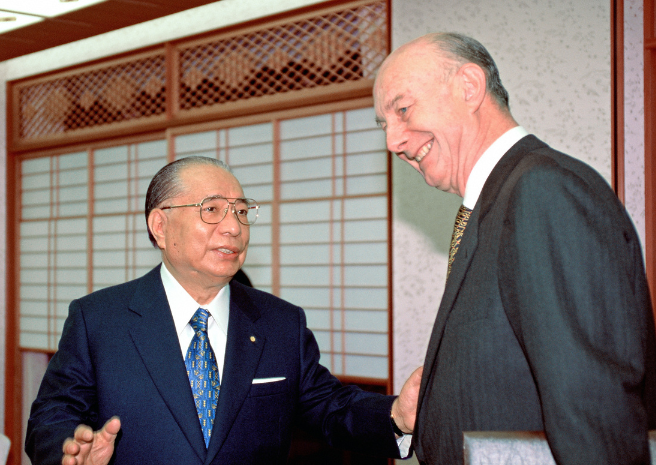
From their first meeting in 1991, Hochleitner and Ikeda also affirmed that a successful global revolution would require this process of inner transformation. Hochleitner believed that true leaders are not authoritative bosses but humble “servants” who must constantly learn from the younger generation. He said to Ikeda, “The Club of Rome is an organisation dedicated to serving youth… SGI and we are organisations with a common purpose.” He knew that any movement, however intellectually powerful, that fails to listen to the “voices of the future” will ultimately fail to move the human soul.
Decades later, Daisaku Ikeda also met with then Club of Rome Co-President Ernst Ulrich von Weisacker and held a dialogue with him on the urgent issues continuing to confront humanity. They discussed the need for a human revolution and proposed an Asian-European alliance that would harness the best ideas from both science and spirituality to help build a world in which ideas of growth are subordinate to ethical values such as sustainability and social justice.
From philosophy to action
Today, we are taking this philosophical legacy and translating it into urgent, modern action. Through our joint “Human Revolution” project launched in 2024, the Club of Rome and SGI have been hosting dynamic events around the world, such as the It’s Time for Human Revolution held at Taplow Court, UK and Reflect, Unite, Act: Dialogues for a shared future at Sapienza University, Italy.
In these youth-led spaces, we are not just talking theory; we are exploring how to catalyse this inner transformation today. We are proving that prioritising human connection and self-reflection is the most effective starting point for driving systemic change.
Taking root in the Amazon
This momentum is now taking root in concrete, localised action, most notably in our latest initiatives in Brazil. Through a powerful partnership involving the Soka Amazon Institute, SGI, Earth Charter International and the Club of Rome, at the end of August 2026, we brought the concept of the human revolution directly to the frontlines of environmental stewardship and protection.
We listened to young people and worked with them to begin creating a clear, inspiring path toward planetary citizenship. By immersing our participants in the rich socio-biodiversity surrounding the Soka Amazon Institute, we aimed to empower youth to take ownership of their local communities and environments while maintaining a global perspective. This event demonstrated how an inner shift translates into protecting our shared Earth.
The power of one
When faced with grand visions and colossal global challenges, it is entirely natural to feel powerless. I, too, sometimes feel small against the sheer scale of our planetary challenges. But the half-century of dialogue and history we share with the Club of Rome reminds me of the immense power a single individual holds.
We do not need to solve the entire world’s problems overnight. By simply and earnestly engaging in sincere dialogue with the person right in front of us, we can spark a human revolution. Changing the world begins with changing ourselves. As the youth at Taplow Court reminded us, we must first transform the systems within our own hearts. I firmly believe that this quiet, inner shift is exactly how we will begin to build the peaceful, sustainable future we so desperately need.

No comments yet