
Bridging the dichotomy: Why and how Africa must reimagine conservation and development
By Simangele M. Msweli, Associate Director of Conservation Education and Youth Leadership at the African Wildlife Foundation, and Edwin Tambara, Director of Global Leadership at the African Wildlife Foundation
16 July 2026
Africa’s supposed choice between conservation and development is not natural. It is inherited.
For decades, the continent has been asked to choose between protecting its natural wealth and pursuing the economic growth its people deserve. Under this framing, protected landscapes become barriers to progress, while mining, agriculture, infrastructure and industrial expansion are presented as the unavoidable route to prosperity. The debate is reduced to a damaging question: who comes first, people or nature?
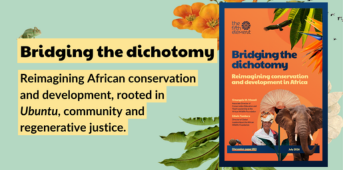
In the Fifth Element’s new discussion paper, ‘Bridging the dichotomy: Reimagining conservation and development in Africa‘, we reject the premise of that question. We argue that the conflict between ecological protection and human advancement is not inevitable. It is the product of colonial systems that separated communities from landscapes they had inhabited, governed and cared for across generations, and of policies that have perpetuated that separation. The paper offers a different starting point: Africa’s ecosystems and its people are not competing interests. They are mutually dependent foundations of the continent’s future.
Africa’s history of conservation did not begin with colonial rule. Long before conservation became a formal profession, communities managed ecosystems and wildlife through customary governance, spiritual belief, cultural identity and shared responsibility. Totemic traditions in southern Africa protected species through clan identity. Maasai pastoral systems used seasonal movement to sustain rangelands. Forest peoples in the Congo Basin developed intimate knowledge of ecological rhythms. Sacred groves among Akan communities placed limits on human use. Conservation was embedded in belonging, responsibility and reciprocity.
Colonial rule fractured these relationships. Protected areas were frequently established through dispossession and forced removal, replacing shared stewardship with exclusion and control. At the same time, colonial economies accelerated the extraction of land, wildlife and raw materials for foreign benefit. Conservation became associated with restriction, while development became associated with exploitation. That history created a divide that continues to shape policy and practice: nature is treated as something to protect from people, while development is treated as something that must happen at nature’s expense.
Africa cannot build a resilient future on that false choice. The continent’s ecological wealth is one of its greatest economic assets. Biodiversity, freshwater systems, fertile lands, forests, grasslands and carbon sinks underpin food security, agriculture, tourism, energy, public health and millions of livelihoods. Yet nature is still pushed to the margins of economic planning, as though ecosystems were amenities rather than essential infrastructure. When ecosystems collapse, economies inherit the cost through floods, drought, food insecurity, displacement and conflict.
The task is not to balance conservation against development, but to design development through ecological reality. Healthy ecosystems make settlements safer, economies more productive and communities more resilient. Development that destroys its own foundations is not progress; it is deferred decline. The paper therefore calls for a shift from extraction to regeneration, from exclusion to stewardship, and from short-term gain to long-term collective wellbeing.
Contemporary approaches such as community-based conservation, localisation, rights-based conservation, Indigenous-led stewardship and equitable benefit-sharing seek to repair the separation between people and nature. But many of their core principles are not new to Africa. Interdependence, reciprocity, collective responsibility and care for present and future generations have long been embedded in African knowledge systems. Ubuntu, often expressed as “I am because we are,” provides a powerful organising philosophy for recovering that relationship. Applied to conservation and development, Ubuntu moves the debate beyond protecting nature from people or exploiting nature for people. It asks how people can care for the natural world together, for shared and intergenerational wellbeing.
The discussion paper translates this philosophy into seven connected areas of action.
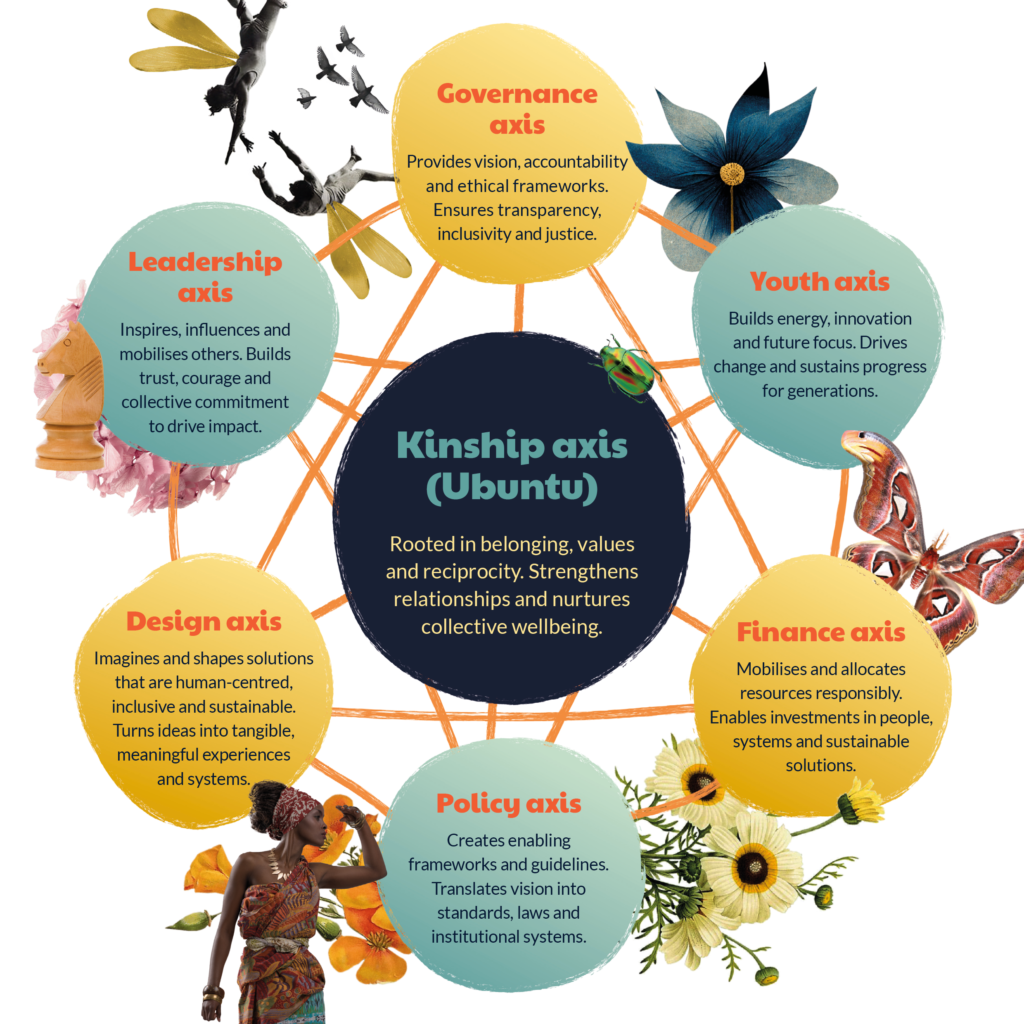
Kinship restores an ecology of belonging, recognising communities as custodians and beneficiaries rather than threats. Leadership places authority closer to the people who know and live with the land. Design treats nature as foundational infrastructure. Policy strengthens Africa’s power to shape national and global agendas on its own terms. Finance values the investment Africans already make through public budgets, community labour and forgone opportunities, while building biodiversity economies with broad African ownership. Youth connects conservation to jobs, enterprise, innovation, identity and justice. Governance underpins them all, because transformation needs transparent, capable and accountable institutions.
Together, these seven axes shift the central question from whether people or nature should come first to how both can flourish together. They offer a framework for moving beyond symbolic inclusion towards authority, ownership and shared benefit. They also insist that those who bear the costs of conservation must have a meaningful role in defining its purpose and sharing in its rewards.
‘Bridging the dichotomy’ is not a call to romanticise the past or reject modern development. It is a call to recover what colonial systems obscured and current systems perpetuated: human prosperity is inseparable from living systems. Africa does not need to choose between ecological integrity and economic progress. It can pursue a regenerative model in which ecosystems strengthen economies, and economic opportunity gives communities greater power to restore the landscapes on which they depend.
That future will require confronting historical injustice, reforming institutions, devolving authority and recognising communities as leaders. The choice before Africa is not people or nature. It is between inherited systems that keep them divided and a new development story that allows both to thrive. ‘Bridging the dichotomy: Reimagining conservation and development in Africa’ invites readers to help imagine, debate and build that story.
No comments yet