
Why we need plural pathways to an ecological future
By Binbin Wang, Chair & Chief Scientist, Climate Future Global Innovation Lab (C Force Lab); Associate Research Professor, Institute of Carbon Neutrality, Peking University
16 April 2026
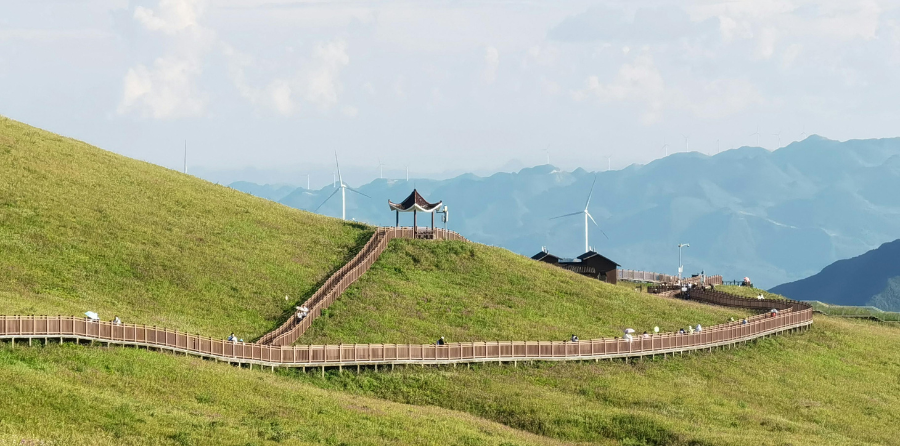
Credit: Pexels
From energy swap to system redesign: Insights from China’s transformation and ancient wisdom
When we gather at forums like the one organised by the Club of Rome in Suzhou, China, in November 2025 to explore how to advance ecological civilisations, questions of energy and decarbonisation emerge as part of a wider transformation: are we merely swapping energy technologies, or are we reimagining civilisation itself?
For decades, the climate conversation has oscillated between technological optimism and political negotiation. Yet as we continue to breach planetary boundaries, it is becoming clear that neither clean energy infrastructure nor carbon markets alone can mend the broken relationship between human societies and the living Earth. What if the real breakthrough lies not in inventing new technologies, but in reclaiming ancient wisdom?
This conviction has shaped my work and thinking: the energy transition should not be just a technological substitution, but a historic civilisational shift – from “energy swap” towards “systemic redesign” and “civilisational reflection”. This idea of a civilisational shift is what my colleagues and I have developed as civilisation-based solutions (CbS) in a recent article.
Three dilemmas, three shifts
I see our challenges operating at three interconnected levels:
The techno-systemic dilemma: This is what we most often discuss—how to integrate intermittent renewables into ageing grids built for fossil fuels. There is no doubt that if China can achieve this breakthrough, it will immediately and comprehensively embrace new energy to achieve energy independence. This is a global engineering challenge, yet it is the most superficial layer.
The socio-equity dilemma: This is the human dilemma. In my fieldwork, I have met farmers forced off their land due to climate impacts. For billions of ordinary people worldwide, this transition is first and foremost about livelihoods and justice. If we cannot build a fair and just society within our green future, we will not achieve equitable wellbeing for all on a healthy planet.
And the deepest layer, which fuels the first two, is the civilisational-values dilemma. At its core lies the anthropocentric worldview of the industrial age: seeing nature as an object to be conquered and endlessly exploited. This is the root cause of our crises.
So, where is the way out? I suggest that it lies in our ability to engage in meaningful “dialogue of civilisations” and embrace plural pathways.
Where ancient wisdom meets modern challenges
Let me share a story that profoundly shaped my thinking. As a Yale World Fellow in 2023, I spoke with the leading scholar in ecology and religion, Mary Evelyn Tucker. When our conversation drifted from carbon neutrality to the roots of civilisational paradigm, she emphasised that the ancient Chinese wisdom of “the unity of heaven and humanity” (tian ren he yi) is a vital contribution to the vision of ecological civilisation: a development model that seeks harmony between human and nature. Her parting words, “This is your destiny,” resonated deeply.
This encounter drew me back to China’s context. China’s green transition is not merely a technological project; it is an attempt to translate such philosophical underpinnings into practice. From my perspective, China’s green transformation serves as a grand laboratory for human civilisation. Its successes or failures offer invaluable lessons for all. Conversely, the world’s diverse experiments in regeneration are equally crucial for China. This mutual interdependence is precisely why we advocate for plural pathways.
Becoming bridge builders
Therefore, the path forward lies in deeper connection, not in isolated technological solutions. We need more civilisation-based solutions and bridges that connect:
- Technology and ethics, so that innovation serves planetary peace and human security.
- Global goals and community action, making justice the core of the transition.
- Knowledge and wisdom from originary cultures and ancient civilisations, together with modern science, harnessing all knowledge for a regenerative future.
For decades, from Copenhagen to Yale, I have embraced the role of a “bridge builder.” Today, each of us can build these bridges. As the Chinese saying goes, “harmony in diversity.” Let us strive to be not only engineers of energy systems but also architects of plural pathways toward peaceful and ecological civilisations.
We invite you to join this crucial “Ancient wisdom for modern challenges” global dialogue. The wisdom for our crisis is already here, woven into the world’s enduring lifeways. It is time we learned to listen and to build anew.

How refreshing. I’m biased, but underlying our crises and failures to solve them, is a self-centred values system that is stuck in an adolescent paradigm.
Your ‘bridge builders’ approach is so refreshing. I’ve been researching what it might take to move from an adolescent civilisation to a wise, compassionate regenerative civilisation, where all life is considered sacred.