
From separation to reconciliation: Love and leadership through The Fifth Element
Raad Sharar, Programme Lead at the Club of Rome
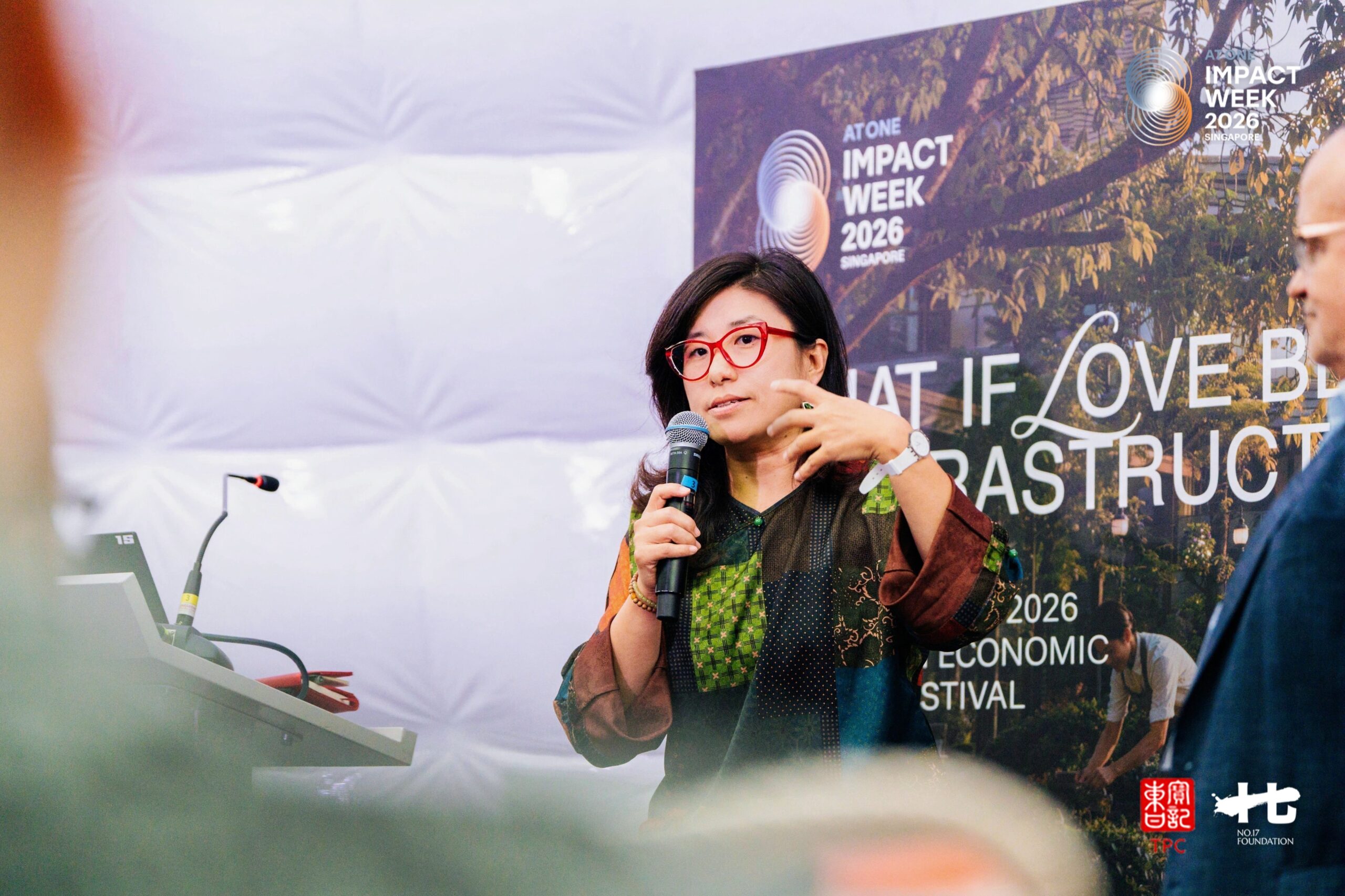
Binbin Wang, founder of C-Force Lab
Impact Week 2026 carried a bold theme, “Love as Infrastructure,” and one session sharpened it into a more explorative question: Love is not a leadership competency, or is it? Carlos Álvarez Pereira, Secretary General of the Club of Rome, opened with an engineer’s candour. Infrastructure evokes bridges, highways and digital networks, all products of rational design, and love belongs to the world of feeling, something people sense and carry within them. The session focused on uniting these two elements and drawing the discussion toward their meeting point.
The Club of Rome’s Fifth Element programme offered a fitting lens. Its discussion paper, Dancing with Paradigms, sets out an ambitious aim: reconciliation among humans, with all living beings and with time. It pursues that aim through a handful of guiding commitments. It bets on “the humanity and capacity of everybody” to learn and change. It embraces pluriversality, honouring the many context-rooted pathways toward wellbeing on a healthy planet. It works across chasms of generation, geography, discipline and worldview. And it weaves ancient wisdom together with modern science to close what the Club of Rome calls the “human gap,” the distance between our power to transform the world and our capacity to understand the consequences. Read through that lens, the session was asking whether love might be the leadership capacity that makes all of this possible.
“All of us are equipped for love, if we reconnect with our own humanity.” – Carlos Álvarez Pereira, Secretary General of the Club of Rome
Four mentors, one journey
The session’s central voice belonged to Binbin Wang, founder of C-Force Lab at the Institute of Carbon Neutrality, Peking University. She told her story through four encounters she calls her spiritual mentors.
A Tibetan beggar returned the extra money she gave him, explaining that an unearned debt would follow him into his next life. When Binbin suggested that a Yi elder in Sichuan could ease his community’s poverty by felling ancient trees to build a profitable temple, he explained that his life’s task was to protect those trees for future generations. A farmer in Gansu described a decade of failing rains and a hailstorm that erased his harvest, making climate change real for her. And in Antarctica, penguins approached her with open curiosity, treating her as just another creature on the shore.
“In the climate circle, there is a deep anxiety. The more we do, the more huge the crisis seems… So I think the first step is we should help them to stabilise the inner climate.” – Binbin Wang, founder of C-Force Lab
Years of climate policy work followed, until a persistent question led her toward the Chinese philosophy of Tian Ren He Yi, the unity of humanity and heaven. That search gave rise to her C-Force lab and its framework of 3C leadership: curiosity, courage and compassion. Her conviction is that leaders who first steady their inner climate become far better equipped to care for the outer one.
The thread that holds it together: Relationship
Of everything shared in the room, one notion merits special attention that Carlos mentioned directly: relationship. Every story Binbin told was about a relationship being restored, with a debt, a forest, a farmer’s field, and a colony of penguins. Seen this way, love as a leadership competency becomes the capacity to stay in relationship.
“It’s really surprising how far we can go in thinking about the world while excluding this concept of relationship, that we are related.” – Carlos Álvarez Pereira, Secretary General of the Club of Rome
Our crises can be traced to a gradual drift in how we relate to one another: from distinction, to separation, and finally to the fantasy of exclusion, the belief that what happens to others has little to do with us. Carlos brought this to life with a timely example. As Europe talks of preparing for war, he reminded the room that this is the continent that lived through two world wars and urged it to learn from that history. Preparing for war against Russia, or treating China as a threat, deepens division, while lasting security grows from healing our relationships, even with those we call enemies.
Binbin’s mentors all had one thing in common: they held wisdom outside of traditional positions of power. The Yi elder viewed the forest as a legacy held in trust for future generations. The beggar regarded a simple trade as sacred. The Gansu farmer observed the shifting climate in his own soil. And the penguins, meeting a stranger with curiosity, reminded her that humans are part of the chain of life. Together, they reflect a hopeful truth: the ability to govern with compassion exists throughout humans and the natural world. Her research on “Ancient Intelligence,” drawing on traditions from China, India, Indonesia, Africa and the Americas, carries that insight forward, inviting many ways of knowing into conversation with modern science.
A room full of evidence
The open discussion gave this framework life. A participant from the United States remarked that US business culture emphasises measurable targets and views care as a career risk. An educator from the Philippines proposed framing love around character and ideals.
Kate Goldman-Toomey of Open Planet asked how people can come to love a world they have yet to experience directly. Her question touches a conviction at the core of The Fifth Element: that storytelling and artistic practice can shift the meanings we live by, making storytelling itself a leadership tool. Binbin further answered in spirit, calling everyone in the room a spark, an image synonymous of The Fifth Element’s idea of a “resonating mycelium”: a living network through which local efforts strengthen each other.
“I think everyone here in this room is a spark… We know each other, we identify with each other, and then we contribute our resources and our networks. We come together and change the future.”
A competency grown in relationship
The session closed with its question still open, which suited it well for The Fifth Element, which celebrates questions that are meant to live and breathe. What emerged clearly is a richer picture of the competency at stake. Love in leadership grows through relationships, reciprocity, and the humility to learn from a beggar, a farmer, an elder and a penguin.
Read more about the session at Impact Week HERE.
No comments yet